Material Studies (selected work)
Material Studies is an ongoing body of work concerned with how materials carry, organize, and complicate ideas of care, relation, protection, and dependency. Working through sculpture, installation, textiles, drawing, found objects, and writing, I use the studio as a space for testing how these ideas might take physical form.
Many of these works begin with familiar materials and practices: canvas, cloth, stitching, folding, wrapping, hanging, carrying, and covering. I am interested in their proximity to domestic labour and care, but also in how they can shift when brought into an exhibition space. A piece of cloth might operate as an image, garment, shelter, sculpture, or temporary architecture. Works are often made to remain flexible: they can be folded, transported, hung, draped, suspended, or placed directly on the floor. Their form is not necessarily fixed by a single installation.
This material instability is important to the work. Rather than treating an artwork as an autonomous object, I am interested in what happens when it remains dependent upon bodies, spaces, histories, and other objects. Recent works draw from experiences of caregiving alongside historical, religious, and mythological images of nourishment, sacrifice, protection, and exchange. These references are not intended as illustrations, but as structures that can be taken apart and reconsidered through making.
Material Studies functions as an open field within my practice: a place where research, lived experience, material experimentation, and exhibition can remain in relation without needing to resolve into a singular form.
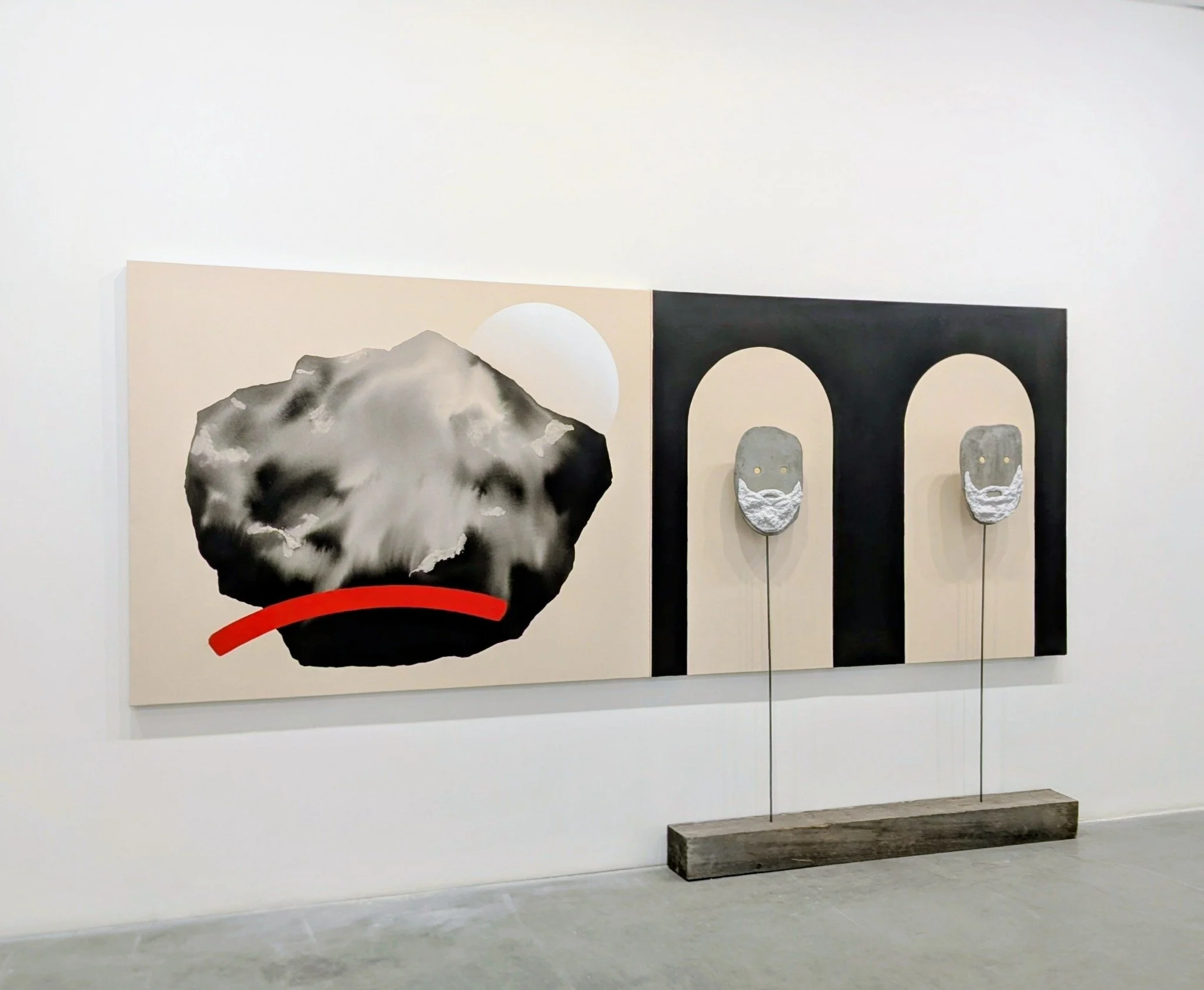
Two Lovers, 2024
Canvas, ink, oil paint, wood, ceramic, steel
72 × 108 in (183 × 274 cm)
Two Lovers imagines a fictional event in which two priests engaged in colonial missionary work fall in love and abandon their missionary duties to live their lives together. The work uses this speculative narrative to consider the possibility of stepping outside inherited systems of belief, authority and obligation. Their relationship becomes an imagined act of refusal and transcendence—a movement away from prescribed roles and toward another way of being in relation to one another.
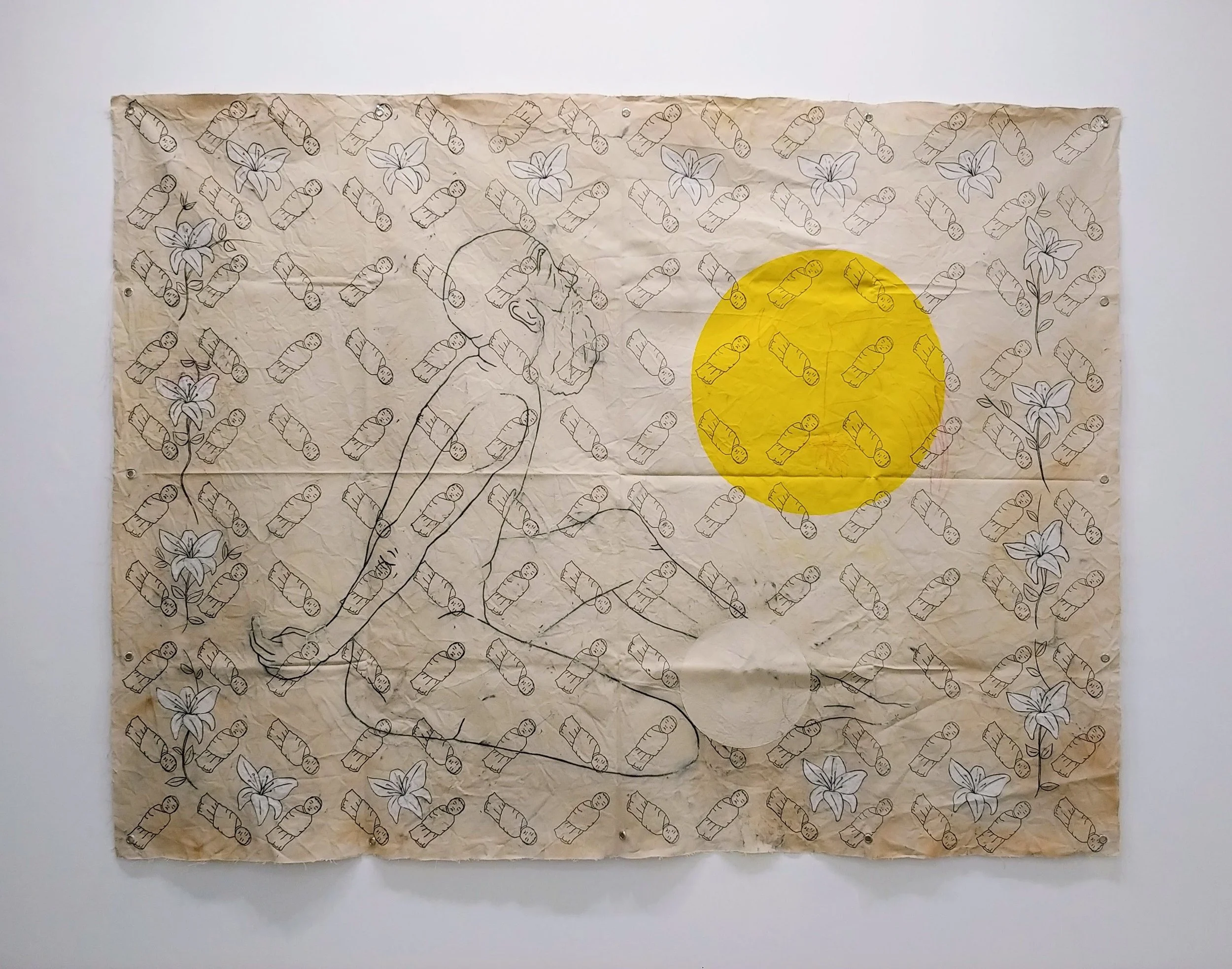
Cimon (from Cimon and Pero) with Baby Pattern, 2024
Canvas, ink, grommets
89 × 67 in (226 × 170 cm)
This work develops my ongoing interest in the story of Cimon and Pero, in which Pero secretly breastfeeds her imprisoned and starving father. I approach the story as an image of care that exceeds conventional boundaries of propriety, intimacy and familial roles. By placing Cimon among a repeated pattern of babies, I use the story to consider care as a potentially radical and destabilizing relationship.
The unstretched canvas is foldable and designed to accommodate different forms of installation. Its grommets allow it to be hung from a wall or other architectural structure, while it may also be draped, suspended or placed directly on the floor.
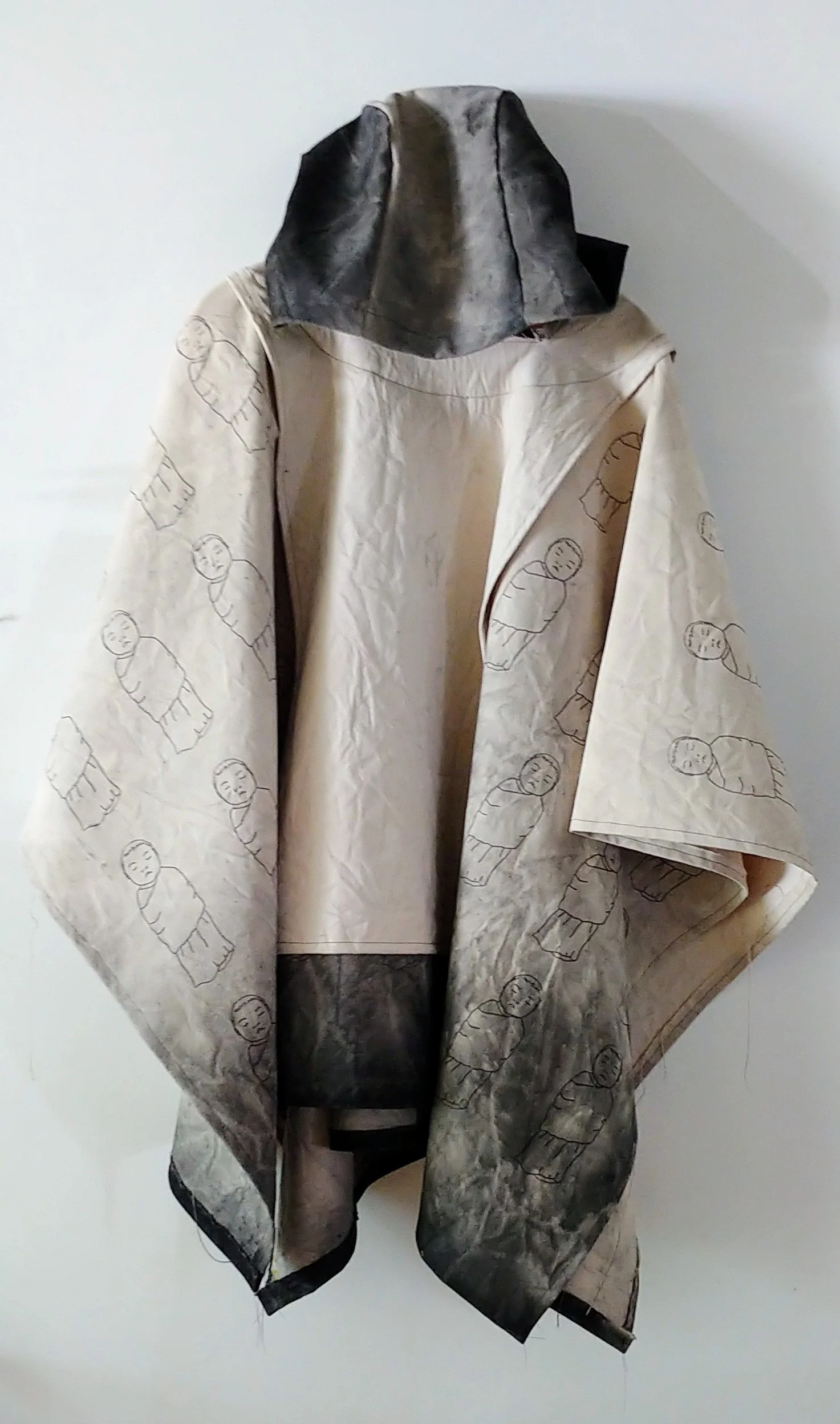
Hooded Poncho with Baby Pattern, 2024
Stitched canvas, ink
48 × 24 × 6 in (122 × 61 × 15 cm)
Developed through my experience of caring for Emerald, this work considers domestic care as part of artistic practice rather than something separate from it. The hooded poncho functions as both garment and shelter, while the repeated baby pattern moves an intimate image of dependency and care into ornament. The work considers protection as both a physical and relational act.
The work is soft and foldable and does not require a fixed installation. It can be suspended, hung against a wall, draped over a structure or presented on the floor, allowing its relationship to the body and surrounding space to change with each installation.
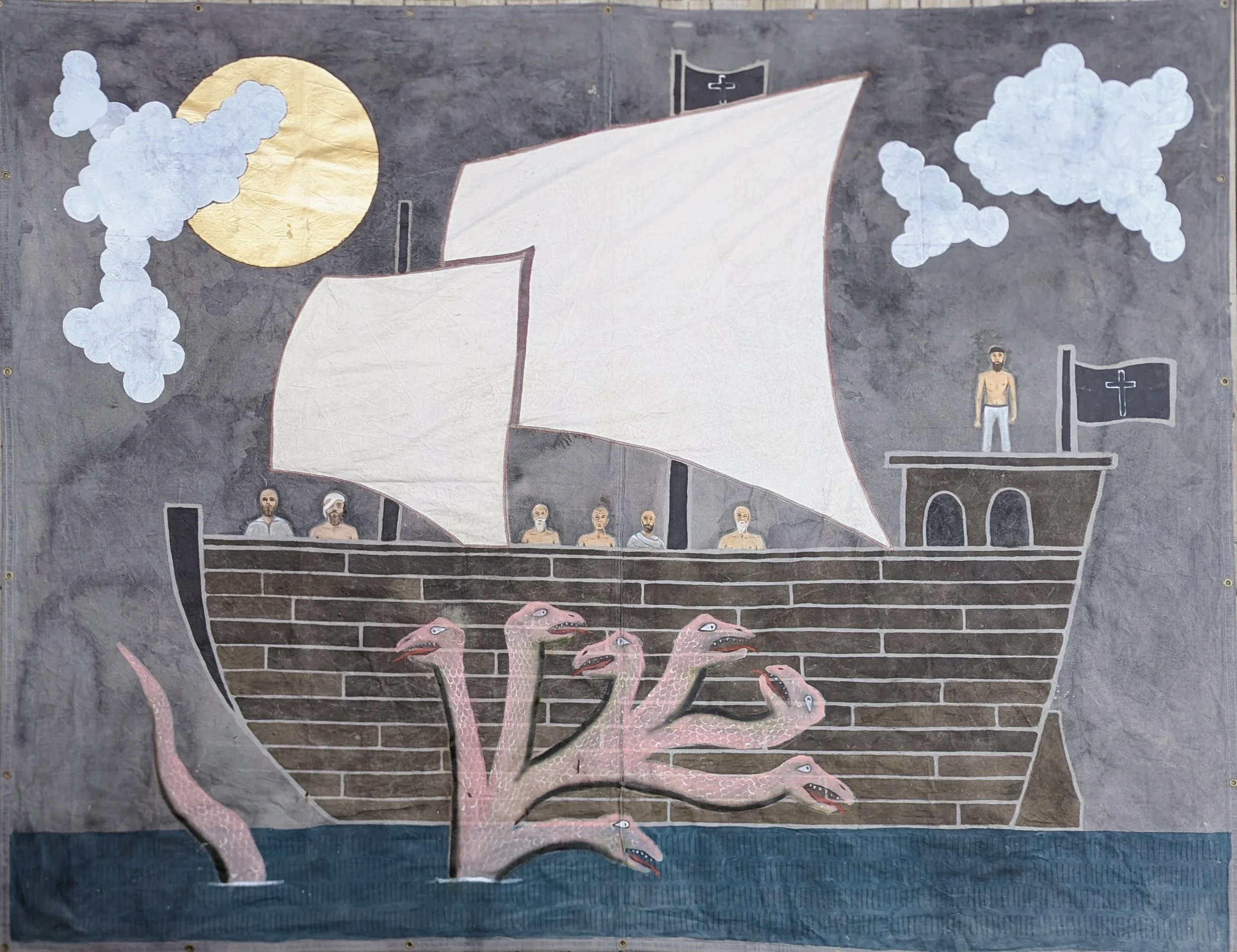
Lake of Fire with Beast, 2026
Canvas tarp, grommets, thread, paint, bleach
108 × 144 in (274 × 366 cm)
This work draws from my ongoing interest in Christian mythology and its visual traditions, particularly images of hell, judgment, monsters and salvation. Through the ship, male figures and many-headed beast, I consider how inherited religious mythologies construct ideas of masculinity, authority, fear and redemption. The directness of the imagery and worked canvas surface bring these monumental narratives into a provisional, bodily and strange register.
Despite its large scale, the work is unstretched and completely foldable. Grommets allow it to be attached to walls or architectural structures, but it can equally be suspended, draped or installed on the floor. This flexibility is intentional, allowing the work to respond to the architecture and conditions of each exhibition space.