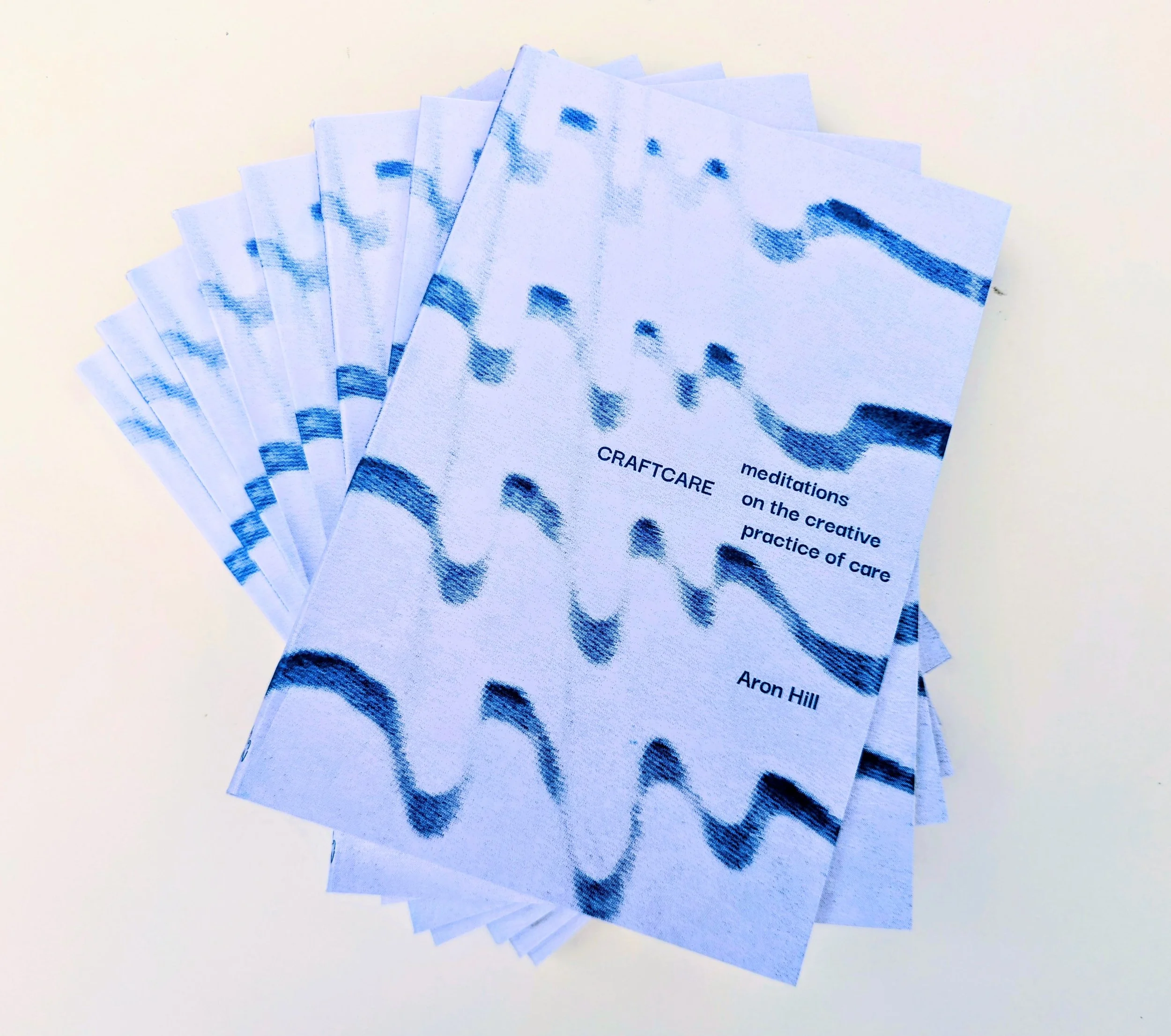
Craftcare, Meditations on the Practice of Care, Author: Aron Hill
Designer: Jesus Caba
2025 - ongoing
This is a meditation on how care-based labor can foster a therapeutic reality that cultivates a reciprocal relationship between craft and the world it inhabits.
We live in a world where competition and consumption dominate, often overshadowing our capacity for care and leaving little room for nurturing practices. Reorienting ourselves toward care disrupts our current reality and encourages us to look towards the horizon and beyond.
This is an ongoing research project; below is a working library:
CARECRAFT — WORKING RESEARCH LIBRARY
1. CARE, KINSHIP, AND RELATION
Segal, Lynne. Lean on Me: A Politics of Radical Care. Verso, 2023.
Segal develops care as a collective and political practice rather than a private responsibility. She considers interdependence, solidarity, and mutuality as alternatives to competitive individualism.
Puig de la Bellacasa, María. Matters of Care: Speculative Ethics in More Than Human Worlds. University of Minnesota Press, 2017.
Develops care simultaneously as ethical orientation, material practice, and mode of thought. Extends questions of care into ecological, technological, material, and more-than-human relations.
Kimmerer, Robin Wall. The Serviceberry: Abundance and Reciprocity in the Natural World. Scribner, 2024.
Uses ecological relationships to consider reciprocity, gift economies, gratitude, responsibility, and abundance as alternatives to economies structured around scarcity and accumulation.
Four Arrows (Wahinkpe Topa) and Darcia Narvaez. Restoring the Kinship Worldview: Indigenous Voices Introduce 28 Precepts for Rebalancing Life on Planet Earth. North Atlantic Books, 2022.
Presents kinship as an ethical and ecological orientation connecting humans with land, community, ancestors, other species, and future generations.
Stiegler, Bernard. Taking Care of Youth and the Generations. Translated by Stephen Barker, Stanford University Press, 2010.
Examines care through education, attention, technology, cultural transmission, and intergenerational responsibility. Particularly relevant to the relationship between care and the preservation and transmission of knowledge.
Lewis, Sophie. Abolish the Family: A Manifesto for Care and Liberation. Verso, 2022.
Critiques the privatization of dependency and care within the nuclear family. Considers how care might instead circulate through expanded networks of intimacy, responsibility, and collective life.
Glissant, Édouard. Poetics of Relation. Translated by Betsy Wing, University of Michigan Press, 1997.
Develops relation, opacity, difference, encounter, and interconnected histories as alternatives to identity based upon singular origins. Especially important is Glissant's insistence that relation does not require complete knowledge of the other.
2. QUEERING, BODIES, AND ALTERNATIVE RELATIONS
Ahmed, Sara. Queer Phenomenology: Orientations, Objects, Others. Duke University Press, 2006.
Examines how bodies become oriented toward particular objects, spaces, people, and possibilities. Queering becomes a means of deviating from the paths that institutions and social norms make appear natural.
Sedgwick, Eve Kosofsky. Touching Feeling: Affect, Pedagogy, Performativity. Duke University Press, 2003.
Explores affect, embodiment, pedagogy, vulnerability, pleasure, and repair. Her concept of reparative reading provides an important alternative to critical practices concerned primarily with exposure and suspicion.
Lorde, Audre. Sister Outsider: Essays and Speeches. Crossing Press, 1984.
Brings together writings on difference, race, sexuality, gender, anger, creativity, care, and political solidarity. Difference becomes a potentially generative basis for collective life rather than something that must be overcome.
Butler, Judith. The Force of Nonviolence: An Ethico-Political Bind. Verso, 2020.
Develops an ethics of nonviolence around interdependency, vulnerability, grievability, and relationality. Challenges the idea of the autonomous individual as the fundamental political subject.
Daring, C. B., J. Rogue, Deric Shannon, and Abbey Volcano, eds. Queering Anarchism: Addressing and Undressing Power and Desire. AK Press, 2012.
Brings queer and anarchist thinking together to question supposedly natural arrangements of sexuality, gender, family, authority, and hierarchy.
Nelson, Maggie. The Argonauts. Graywolf Press, 2015.
Combines memoir, critical theory, sexuality, gender, parenthood, and family life. Particularly relevant for its refusal to separate intellectual practice from domestic, embodied, intimate, and caregiving experience.
Preciado, Paul B. An Apartment on Uranus: Chronicles of the Crossing. Translated by Charlotte Mandell, Semiotext(e), 2020.
Uses gender transition alongside migration, borders, sexuality, technology, and political belonging to consider forms of existence outside established categories.
Walker, Nick. Neuroqueer Heresies: Notes on the Neurodiversity Paradigm, Autistic Empowerment, and Postnormal Possibilities. Autonomous Press, 2021.
Develops neuroqueering as a practice of resisting normative expectations concerning cognition, behaviour, embodiment, identity, and social participation.
Wojnarowicz, David. Close to the Knives: A Memoir of Disintegration. Vintage, 1991.
Combines memoir, sexuality, art, political writing, grief, rage, and experiences of the AIDS crisis. Examines the institutional conditions determining whose lives receive recognition, protection, and care.
Solanas, Valerie. SCUM Manifesto. 1967.
A deliberately extreme work of feminist provocation employing satire, inversion, rage, and refusal to destabilize supposedly natural gender and social structures.
Wilde, Oscar. The Picture of Dorian Gray. 1890/1891.
A literary investigation of aesthetics, morality, desire, appearance, secrecy, and social convention. Useful within the broader queer genealogy surrounding aesthetic life and resistance to normative social expectations.
Schneemann, Carolee. Selected writings and works.
Schneemann's practice brings sexuality, domesticity, embodiment, gender, performance, and material experience into direct relationship with artistic production, destabilizing divisions between artwork and life.
3. MAKING, LABOUR, MAINTENANCE, AND CULTURAL PRODUCTION
Arendt, Hannah. The Human Condition. University of Chicago Press, 1958.
Distinguishes labour, work, and action: maintaining biological life, constructing a durable human world, and acting within conditions of plurality. These distinctions provide an important framework for questioning where care and craft belong within cultural production.
Arendt, Hannah. “Labor, Work, Action.” 1964.
A concise formulation of the distinctions developed in The Human Condition, particularly useful for considering making, maintenance, necessity, world-building, and collective action.
Märten, Lu. Selected writings on art, labour, gender, and material production.
Märten's Marxist aesthetic thinking challenges distinctions between fine art and everyday material production. Her writing provides an important historical route into relationships among domestic labour, craft, production, gender, and aesthetics.
Lorey, Isabell. State of Insecurity: Government of the Precarious. Verso, 2015.
Understands precarity not simply as insecure employment but as a broader political condition. Particularly relevant to artistic labour, vulnerability, cultural work, and contemporary institutional life.
Kraus, Chris. Social Practices. Semiotext(e), 2018.
Considers artists whose practices blur boundaries among artistic production, everyday life, community, relationships, and alternative cultural structures.
Chomsky, Noam, and Marv Waterstone. Consequences of Capitalism: Manufacturing Discontent and Resistance. Haymarket Books, 2021.
Provides a political-economic framework for understanding how capitalism structures institutions, labour, inequality, and everyday life.
Florida, Richard. The Rise of the Creative Class. Basic Books, 2002.
Influential account of creativity and cultural labour as economic forces. Useful critically for examining the incorporation of creativity, flexibility, art, and cultural production into contemporary economic development.
Heidegger, Martin. Selected writings on making, producing, technē, and bringing-forth.
Provides a philosophical distinction between forms of making or “bringing-forth” and technological ordering. Potentially important alongside Campagna's distinction between Technic and Magic.
4. ART, INSTITUTIONS, AND POLITICAL AESTHETICS
Marcuse, Herbert. One-Dimensional Man: Studies in the Ideology of Advanced Industrial Society. Beacon Press, 1964.
Examines how advanced industrial society incorporates opposition and reduces possibilities for genuinely alternative forms of thought and life. Art retains importance through its capacity for negation and maintaining distance from established reality.
Bourriaud, Nicolas. Relational Aesthetics. Les presses du réel, English edition 2002.
Proposes artistic practices based upon encounters, participation, exchange, and social relationships rather than exclusively autonomous art objects.
Malik, Suhail, and Andrea Phillips. “The Wrong of Contemporary Art: Aesthetics and Political Indeterminacy.” In Reading Rancière: Critical Dissensus, edited by Paul Bowman and Richard Stamp, Continuum, 2011, pp. 111–128.
Challenges contemporary art's assumption that aesthetic indeterminacy necessarily produces meaningful political effects. Particularly important as a critique of Rancière and of contemporary art's claims to criticality.
Levine, Gabriel. Art and Tradition in a Time of Uprisings. MIT Press, 2020.
Examines contemporary reclamations and transformations of tradition through ritual, craft, cooking, music, Indigenous practices, and queer cultural forms. Particularly relevant to profanation, repair, vernacular practice, and remaking damaged worlds.
Welchman, John C., ed. Institutional Critique and After. JRP|Ringier, 2006.
Examines the histories and consequences of institutional critique and the changing relationship among artists, cultural institutions, critique, and institutional power.
Obrist, Hans Ulrich. Lives of the Artists, Lives of the Architects. Penguin, 2015.
Approaches artistic and architectural production through conversations, biographies, working processes, relationships, and networks rather than through finished objects alone.
Williams, Kimberly A. Stampede: Misogyny, White Supremacy, and Settler Colonialism. Fernwood Publishing, 2021.
Examines the Calgary Stampede as a cultural institution through which gender, race, colonial mythology, and Western Canadian identity are produced and maintained.
Unsettling Canadian Art History.
Scholarship challenging Canadian art histories that marginalize Indigenous artists, knowledge, and colonial histories. Particularly relevant to museums, galleries, archives, collecting, and representation as institutional practices.
e-flux. Agency of Unrealized Projects.
Uses unrealized artistic projects to consider possibility, failure, imagination, resources, and institutional constraint, shifting attention from completed artworks toward propositions and unrealized futures.
5. INDIGENOUS KNOWLEDGE, SOVEREIGNTY, AND DECOLONIZATION
Justice, Daniel Heath. Why Indigenous Literatures Matter. Wilfrid Laurier University Press, 2018.
Considers Indigenous literature through questions of relationship, responsibility, sovereignty, cultural continuity, and what it means to become good relatives and ancestors.
Carlson-Manathara, Elizabeth. Living in Indigenous Sovereignty. Fernwood Publishing, 2021.
Approaches sovereignty as something enacted through everyday relationships, responsibilities, knowledge, and practices rather than exclusively as a legal or political status.
Treaty 7 Elders and Tribal Council. The True Spirit and Original Intent of Treaty 7. McGill-Queen's University Press, 1996.
Presents Treaty 7 through Elders' accounts and Indigenous understandings, emphasizing treaty as an ongoing relationship involving land, reciprocity, responsibility, and coexistence.
Goulet, Jean-Guy A. Ways of Knowing: Experience, Knowledge, and Power Among the Dene Tha. University of Nebraska Press, 1998.
Based upon extended engagement at Chateh, Goulet examines Dene Tha' knowledge through experience, dreams, spirituality, healing, participation, trust, and relationships.
Fromhold, Joachim. Dene Tha First Nation: Historical Overview.
Provides historical context concerning Dene Tha' territory, community organization, settlement, and encounters with colonial institutions.
Regan, Paulette. Unsettling the Settler Within: Indian Residential Schools, Truth Telling, and Reconciliation in Canada. UBC Press, 2010.
Approaches reconciliation from the position of settlers, emphasizing responsibility, humility, discomfort, truth-telling, and transformation rather than simply learning about Indigenous peoples.
Tuck, Eve, and K. Wayne Yang. “Decolonization Is Not a Metaphor.” Decolonization: Indigeneity, Education & Society, vol. 1, no. 1, 2012.
Insists upon the material relationship between decolonization, Indigenous land, and sovereignty, resisting the transformation of decolonization into a general metaphor for institutional or social improvement.
Johnson, Harold R. Peace and Good Order: The Case for Indigenous Justice in Canada. McClelland & Stewart, 2019.
Critiques Canadian criminal justice through Indigenous relational and legal perspectives, contrasting adversarial punishment with responsibility, relationship, balance, and community.
Villanueva, Edgar. Decolonizing Wealth: Indigenous Wisdom to Heal Divides and Restore Balance. Berrett-Koehler, 2018.
Examines philanthropy and institutional giving as structures capable of reproducing colonial relationships and proposes reciprocity, redistribution, trust, relationship, and healing as alternatives.
Grosfoguel, Ramón. Selected writings on epistemic racism, coloniality, and Western knowledge.
Examines how colonial hierarchies operate within systems of knowledge and institutions, questioning the presumed universality of Western epistemological traditions.
Yellowhead Institute. Research reports on Indigenous sovereignty, land, governance, and policy.
An ongoing source of Indigenous-led analysis addressing contemporary Canadian policy, jurisdiction, land, governance, treaty, and Indigenous sovereignty.
6. INDIGENOUS LITERATURE, MEMOIR, AND STORY
Belcourt, Billy-Ray. A History of My Brief Body. Hamish Hamilton, 2020.
Combines memoir, poetry, criticism, and theory to consider queer Indigenous life, colonialism, grief, desire, love, embodiment, and possibilities for collective life.
Belcourt, Billy-Ray. A Minor Chorus. Hamish Hamilton, 2022.
Explores community, memory, desire, grief, storytelling, and the ethical difficulty of transforming the experiences of others into artistic material.
Good, Michelle. Five Little Indians. HarperCollins, 2020.
Follows residential-school survivors attempting to establish adult lives, emphasizing friendship, love, displacement, trauma, survival, and relationships as sites of resilience.
Knott, Helen. In My Own Moccasins: A Memoir of Resilience. University of Regina Press, 2019.
Connects personal experiences of trauma, addiction, motherhood, and healing with colonial histories, community, ceremony, land, family, and cultural reclamation.
Thistle, Jesse. From the Ashes: My Story of Being Métis, Homeless, and Finding My Way. Simon & Schuster Canada, 2019.
Connects experiences of family separation, homelessness, addiction, incarceration, education, and belonging to broader histories of colonial displacement.
Whitehead, Joshua. Jonny Appleseed. Arsenal Pulp Press, 2018.
Explores queer/Two-Spirit Indigenous life through sexuality, family, friendship, humour, grief, memory, and complicated relationships to home and community.
Wente, Jesse. Unreconciled: Family, Truth, and Indigenous Resistance. Allen Lane, 2021.
Combines memoir and cultural criticism to examine Indigenous representation, colonialism, family, media, and the limitations of symbolic reconciliation.
King, Thomas. The Inconvenient Indian: A Curious Account of Native People in North America. Doubleday Canada, 2012.
Uses history, criticism, memoir, and humour to examine colonial narratives concerning Indigenous peoples, land, representation, law, and national identity.
Sinclair, Niigaan, ed. Wînipêk: Visions of Canada from an Indigenous Centre. McClelland & Stewart, 2024.
Centres Indigenous perspectives on politics, culture, history, place, and Canada's possible futures, reversing narratives that position Indigenous experience at the margins.
7. REFUSAL, WORLDMAKING, AND OTHER WORLDS
Campagna, Federico. The Last Night: Anti-Work, Atheism, Adventure. Zero Books, 2013.
Critiques work and productivity as dominant principles for organizing contemporary existence. Develops refusal, autonomy, and adventure as possibilities for living otherwise.
Campagna, Federico. Technic and Magic: The Reconstruction of Reality. Bloomsbury Academic, 2018.
Contrasts Technic's reality of measurement, language, abstraction, and productivity with Magic's orientation toward the ineffable and symbolic. Asks whether transforming reality requires transforming the metaphysical structures through which reality itself becomes intelligible.
Campagna, Federico. Prophetic Culture: Recreation for Adolescents. Bloomsbury Academic, 2021.
Considers how cultures might leave fragments, stories, symbols, and practices through which future generations could construct worlds after existing cosmologies cease to function.
Campagna, Federico. Otherworlds: Mediterranean Lessons on Escaping History. Bloomsbury Academic, 2025.
Draws upon Mediterranean cosmologies and histories to investigate alternative constructions of reality and possibilities for escaping the apparent inevitability of the present historical world.
Graeber, David, and David Wengrow. The Dawn of Everything: A New History of Humanity. Farrar, Straus and Giroux, 2021.
Challenges linear accounts of human political development and emphasizes historical experimentation with radically different forms of collective organization.
Benjamin, Walter. Selected essays on art, history, experience, production, storytelling, and material culture.
Benjamin's work offers ways of thinking about how technological and social conditions transform art, experience, objects, history, and cultural production.
Badiou, Alain. Secondary readings and commentary.
Included provisionally around questions of event, rupture, truth, and the emergence of possibilities that cannot be fully accounted for by an existing situation.
The Orphic Hymns.
Ancient ritual poems invoking gods, natural forces, cosmic principles, and relationships between human and divine worlds. Relevant to cosmology, invocation, ritual, and alternative understandings of matter and agency.
Waters, John. Carsick: John Waters Hitchhikes Across America. Farrar, Straus and Giroux, 2014.
Blends imagined possibilities with an actual experiment in travel, chance, encounter, vulnerability, and relinquishing control.
FURTHER READING
AESTHETICS, POLITICS, AND REFUSAL
Marcuse, Herbert. The Aesthetic Dimension: Toward a Critique of Marxist Aesthetics. Beacon Press, 1978.
A particularly important next step after One-Dimensional Man. Marcuse argues for the political capacity of aesthetic form while resisting attempts to reduce art to explicit political content.
Benjamin, Walter. “The Author as Producer.” 1934.
Asks whether politically committed cultural production actually transforms the apparatus through which culture is produced or merely supplies that apparatus with progressive content.
Benjamin, Walter. “The Work of Art in the Age of Its Technological Reproducibility.” 1935–39.
Examines how changing technological conditions transform the production, reception, authority, and political possibilities of art.
Benjamin, Walter. “The Storyteller: Reflections on the Works of Nikolai Leskov.” 1936.
Considers storytelling, experience, memory, craft, community, and the transmission of knowledge, making it potentially important for Carecraft beyond Benjamin's explicitly aesthetic writings.
Benjamin, Walter. “Experience and Poverty.” 1933.
A short but potentially important consideration of the breakdown of transmissible experience and the possibilities of beginning again from conditions of cultural impoverishment.
Rancière, Jacques. The Politics of Aesthetics: The Distribution of the Sensible. Continuum, 2004.
Develops the relationship between politics and aesthetics through what can be seen, heard, said, occupied, and recognized within a shared world.
Rancière, Jacques. The Emancipated Spectator. Verso, 2009.
Challenges models in which knowledgeable artists transmit meaning to passive audiences, proposing instead an emancipated spectator capable of interpretation, translation, and independent association.
Rancière, Jacques. Dissensus: On Politics and Aesthetics. Continuum, 2010.
Extends Rancière's account of politics as disruption of established arrangements of perception, participation, identity, and social possibility.
Malik, Suhail. “Reason to Destroy Contemporary Art.” In Realism Materialism Art, Sternberg Press, 2015, pp. 185–190.
A useful continuation after “The Wrong of Contemporary Art,” pushing Malik's critique of contemporary art's institutionalized commitment to criticality and aesthetic indeterminacy.
Malik, Suhail, and Andrea Phillips. “Tainted Love: Art's Ethos and Capitalization.” In Art and Its Commercial Markets, Sternberg Press, 2012, pp. 209–240.
Especially relevant to the relationship between contemporary art's ethical self-understanding and the economic and institutional systems through which art circulates.
CARE, MAINTENANCE, AND REPRODUCTIVE LABOUR
Ukeles, Mierle Laderman. “Manifesto for Maintenance Art 1969! Proposal for an Exhibition ‘CARE.’” 1969.
A foundational articulation of maintenance—cleaning, sustaining, repairing, caregiving—as artistic practice. Likely one of the most directly relevant artistic precedents for Carecraft.
Tronto, Joan C. Caring Democracy: Markets, Equality, and Justice. New York University Press, 2013.
Develops care as a democratic and institutional question rather than merely a private ethical practice, providing an important bridge between care and political organization.
Federici, Silvia. Revolution at Point Zero: Housework, Reproduction, and Feminist Struggle. PM Press, 2012.
Makes domestic, reproductive, and caregiving labour politically visible and provides an important counterpoint to Arendt's distinctions among labour, work, and action.
INSTITUTIONS AND ALTERNATIVE FORMS OF LIFE
Harney, Stefano, and Fred Moten. The Undercommons: Fugitive Planning & Black Study. Minor Compositions, 2013.
Explores study, collaboration, refusal, and collective practices that operate beneath, within, and against institutional structures.
Illich, Ivan. Tools for Conviviality. Harper & Row, 1973.
Asks what kinds of tools and institutions expand people's capacities to act together rather than making them increasingly dependent upon professionalized systems.
Hartman, Saidiya. Wayward Lives, Beautiful Experiments: Intimate Histories of Social Upheaval. W. W. Norton, 2019.
Examines everyday experiments in intimacy, autonomy, pleasure, and refusal among Black women living within highly restrictive social conditions.
Haraway, Donna J. Staying with the Trouble: Making Kin in the Chthulucene. Duke University Press, 2016.
Develops kin-making, multispecies relations, responsibility, situatedness, and collaborative survival as practices for inhabiting damaged worlds.
Escobar, Arturo. Designs for the Pluriverse: Radical Interdependence, Autonomy, and the Making of Worlds. Duke University Press, 2018.
Connects design, autonomy, interdependence, decolonial thinking, and worldmaking. Particularly useful if Carecraft increasingly considers institutions and structures themselves as things that can be designed differently.
Campagna, Federico. How to Build a World: A Philosophical Guide. Bloomsbury, forthcoming 2027.
A natural continuation of Campagna's broader investigation into metaphysics, alternative worlds, and the construction of realities.